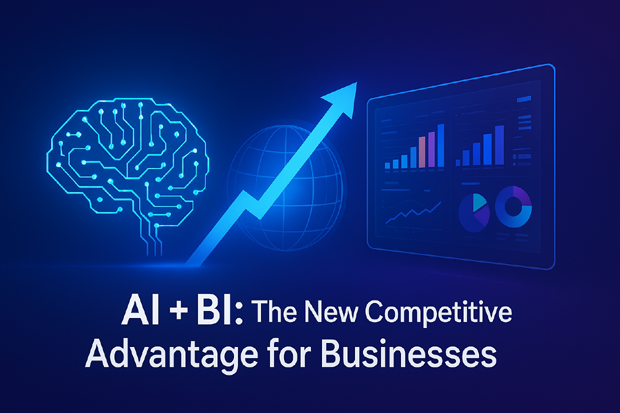
In today’s data-driven economy, businesses no longer compete solely on products, services, or pricing. Instead, the real battlefield lies in how well organizations can harness and interpret their data. Artificial Intelligence (AI) and Business Intelligence (BI) are now merging to create a new competitive advantage, allowing companies to unlock insights faster, make smarter decisions, and adapt quickly in dynamic markets. This integration, often referred to as AI + BI, is shaping the next generation of business success.
The Evolution of Business Intelligence
Traditionally, BI tools focused on reporting, dashboards, and data visualization. Executives and managers could track performance metrics, customer behaviors, and market trends. However, BI was often limited to descriptive analytics, telling businesses what happened in the past. While useful, this left companies with gaps in understanding why it happened or what might happen next. AI bridges this gap by introducing predictive and prescriptive analytics into BI systems. Machine learning algorithms, natural language processing, and advanced data modeling bring the ability to forecast trends, identify patterns, and recommend actions. This transformation pushes BI beyond hindsight into foresight and real-time decision-making.
Why AI + BI is a Game-Changer
1. Smarter Decision-Making
AI-powered BI platforms analyze massive datasets far beyond human capacity. Businesses can move from static dashboards to dynamic insights that evolve continuously, enabling leaders to act on data-driven recommendations rather than intuition alone.
2. Automation of Complex Tasks
Routine processes such as report generation, anomaly detection, and customer segmentation can now be automated. This reduces human error, increases efficiency, and allows analysts to focus on strategy rather than repetitive tasks.
3. Personalization at Scale
With AI, BI systems can deliver tailored insights for different departments or even individuals. A marketing team may receive predictive models for customer churn, while operations get supply chain forecasts. This contextual intelligence empowers each unit to make optimized decisions aligned with organizational goals.
4. Real-Time Competitive Edge
Markets move quickly, and businesses can no longer afford delays in decision-making. AI-enabled BI allows for real-time analytics, where businesses can respond instantly to customer demands, competitor actions, or supply chain disruptions.
Practical Applications of AI + BI
* Retail:
Predicting customer preferences, optimizing inventory, and recommending personalized offers.
* Finance:
Fraud detection, credit risk analysis, and algorithmic trading strategies.
* Healthcare:
Patient risk scoring, treatment optimization, and resource allocation.
* Manufacturing:
Predictive maintenance, quality control, and production efficiency.
These real-world applications demonstrate how the combination of AI and BI extends beyond dashboards—it becomes an operational engine that drives growth and resilience.
Preparing for the Future
To fully leverage AI + BI, businesses must invest in:
* Data Infrastructure:
A strong foundation of clean, accessible, and secure data.
* Upskilling Teams:
Training employees to interpret AI-driven insights effectively.
* Ethical AI Practices:
Ensuring transparency, fairness, and compliance in automated decision-making.
Conclusion
AI + BI is no longer a futuristic concept; it is the present reality reshaping business competition. Companies that embrace this synergy can anticipate market shifts, adapt quickly, and outperform rivals. As organizations continue to digitize, those who fail to harness AI-driven BI risk falling behind. In 2025 and beyond, the true competitive advantage will belong to businesses that transform data into intelligence and intelligence into action.