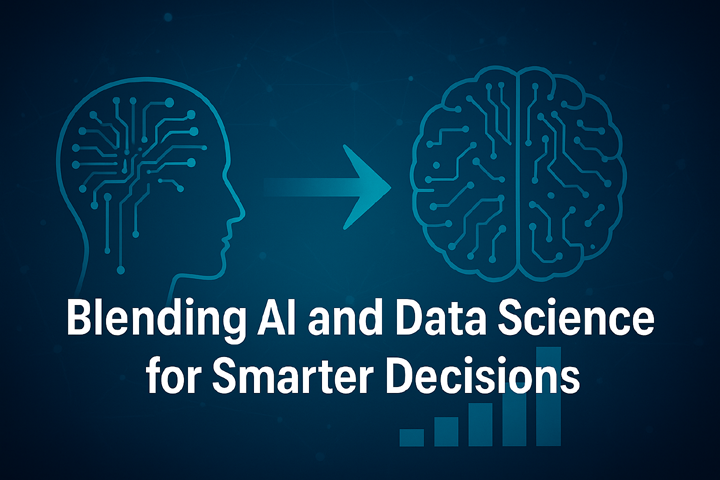
In today’s digitally driven and competitive world, organizations are constantly searching for innovative ways to transform data into actionable intelligence. While data science has traditionally focused on analytics, the convergence of artificial intelligence (AI) and data science is opening up opportunities for smarter, faster, and more informed decision-making. This integration enables organizations to respond dynamically to an unpredictable and complex world, making AI-driven data science a necessity rather than an option.
The Evolution of Data Science and AI
Data science has long been centred on collecting, cleaning, analysing, and interpreting data to build descriptive and predictive models. These models helped organizations understand past behaviour and forecast possible outcomes. AI, on the other hand, has focused on developing systems capable of learning, reasoning, and adapting independently. When combined, predictive models evolve into adaptive intelligence, where machine learning systems continuously learn and optimize based on real-world changes.
Why Blending Matters
Blending AI with data science transforms analytics from descriptive to adaptive. Traditionally, human supervision was required for tasks such as retraining models, tuning parameters, or updating predictions. AI automates these tasks, fine-tuning outputs in real time as new data arrives. This results in greater visibility, reduced operational costs, and the ability to respond instantly to disruptions or competitive opportunities.
Moreover, AI technologies such as natural language processing, computer vision, and reinforcement learning are democratizing data-driven decision-making. Leaders no longer need deep technical expertise to interpret data; they can interact naturally with AI-powered systems through contextual queries, visuals, and actionable insights. This accessibility allows decisions to be made at all levels of an organization.
Real-World Applications
The integration of AI and data science is already reshaping industries:
* Healthcare:
Personalized treatment plans, disease risk prediction, and resource optimization.
* Finance:
Fraud detection, risk assessment, and bias-free investment recommendations.
* Retail:
Demand forecasting, customer behaviour analysis, and supply chain efficiency.
* Manufacturing:
Predictive maintenance through AI-enabled sensors.
* Public Service:
Smarter traffic management, disaster response, and citizen engagement.
These examples highlight that industries are not just experimenting but fully embracing the benefits of AI-driven data science.
Automation and AutoML
A key development at this intersection is Automated Machine Learning (AutoML). AutoML tools simplify building and deploying machine learning models by automating tasks like feature selection, hyperparameter tuning, and model evaluation. This lowers the barrier to entry, empowering small businesses and startups to make data-driven decisions without large teams of experts.
Ethics and Responsible AI
While powerful, AI also introduces ethical challenges. Algorithms can unintentionally embed biases, leading to unfair outcomes. By 2025, organizations are expected to adopt responsible AI frameworks that emphasize transparency, accountability, and fairness. Explainable AI (XAI) will play a vital role in making machine-driven decisions, understandable and trustworthy.
Human-AI Collaboration
The true power of AI lies not in replacing humans but in complementing them. AI brings speed, scale, and accuracy, while humans contribute creativity, empathy, and ethical judgment. Together, they enable more consistent and balanced decisions, blending evidence-based insights with human strategic vision.
Future Outlook
As technologies like quantum computing and advanced AI models mature, the potential of AI-driven data science will grow exponentially. From tackling climate change to accelerating drug discovery, adaptive real-time systems will redefine competitive advantage for organizations willing to embrace this blend early.
Final Thoughts
By merging AI and data science, organizations are entering a new paradigm of automated, ethical, and collaborative decision-making. Success will not only depend on adopting advanced technologies but also on cultivating responsibility, continuous learning, and growth. The future belongs to organizations that can harness this powerful combination to make smarter, fairer, and more meaningful decisions.