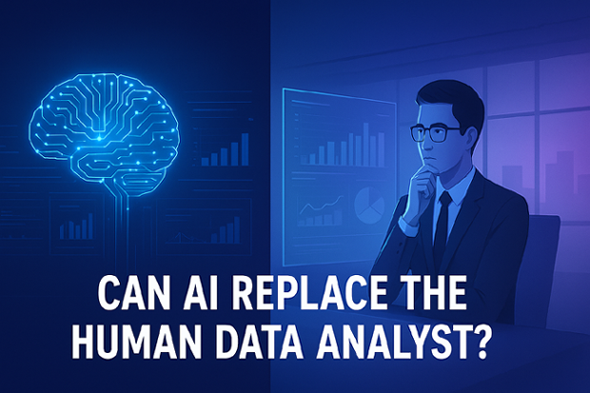
In today’s digital economy, data is one of the most valuable assets across industries. Organizations rely on data-driven insights to guide business decisions, improve efficiency, and enhance customer experiences. With the rapid evolution of Artificial Intelligence (AI), one pressing question arises: can AI replace the human data analyst? The answer lies in understanding the strengths, limitations, and potential collaboration between the two.
The Growing Role of AI in Analytics
AI-powered tools are reshaping how data is processed, analyzed, and visualized. By leveraging algorithms, AI can handle massive datasets far beyond human capacity, identifying patterns and anomalies at speed. For example, AI can scan millions of transactions in seconds to detect fraud, forecast demand, or optimize supply chains. Newer systems incorporate natural language processing (NLP), allowing managers to query data in plain language no need for technical SQL knowledge. This makes analytics more accessible across organizations, blurring the line between traditional analyst responsibilities and AI-powered tools.
The Human Analyst’s Value
Despite AI’s progress, human analysts remain irreplaceable. Analysts bring domain knowledge, contextual awareness, and the ability to connect findings to business goals. While AI may find a correlation between weather and sales, only a human can determine whether it reflects seasonality, causality, or a marketing influence. Human intuition also plays a vital role. Data rarely tells the full story it requires interpretation across organizational, cultural, and social contexts. Analysts know how to ask the right questions, challenge assumptions, and bridge insights to actionable strategies.
Strengths and Weaknesses of AI
AI offers clear advantages:
* Speed & Scale:
Processes terabytes of data in seconds.
* Pattern Recognition:
Detects subtle anomalies and trends.
* Consistency:
Reduces errors caused by fatigue or bias.
* Availability:
Works 24/7 without breaks.
These strengths make AI ideal for repetitive, high-volume tasks such as data cleaning, report generation, and predictive modeling.
However, AI has limitations:
* Lack of Context:
Identifies correlations but cannot explain relevance.
* Ethics & Bias:
Outputs reflect biases in training data.
* Creativity:
Cannot think beyond defined rules.
* Ambiguity:
Struggles with incomplete or messy data.
These gaps reinforce the need for human oversight and interpretation.
The Collaborative Future
The real opportunity is not AI versus humans but AI with humans. AI will handle routine tasks like preprocessing data, identifying anomalies, and visualizing results, freeing analysts to focus on strategic planning, stakeholder engagement, and ethical considerations.
For example:
* Finance:
AI forecasts stock trends, while analysts assess impacts of policies and global events.
* Healthcare:
AI diagnoses diseases from images, but doctors and analysts confirm results with patient history.
* Retail:
AI predicts demand spikes, while analysts align insights with marketing and supply chain realities.
These cases show AI is a powerful assistant—not a replacement—for decision-makers.
Reskilling the Analyst
The future data analyst must evolve into a strategy expert. Key skills will include AI/ML literacy, critical thinking, communication, and ethical awareness. Analysts will increasingly interpret AI-driven outputs, contextualize insights, and guide responsible data use.
Conclusion
So, can AI replace the human data analyst? No. AI excels at speed, scale, and automation, but humans bring judgment, creativity, and ethical reasoning. The future lies in a hybrid model where AI augments human intelligence, handling repetitive tasks while analysts focus on strategy and innovation. Organizations embracing this partnership will be best positioned to thrive in a data-driven world.